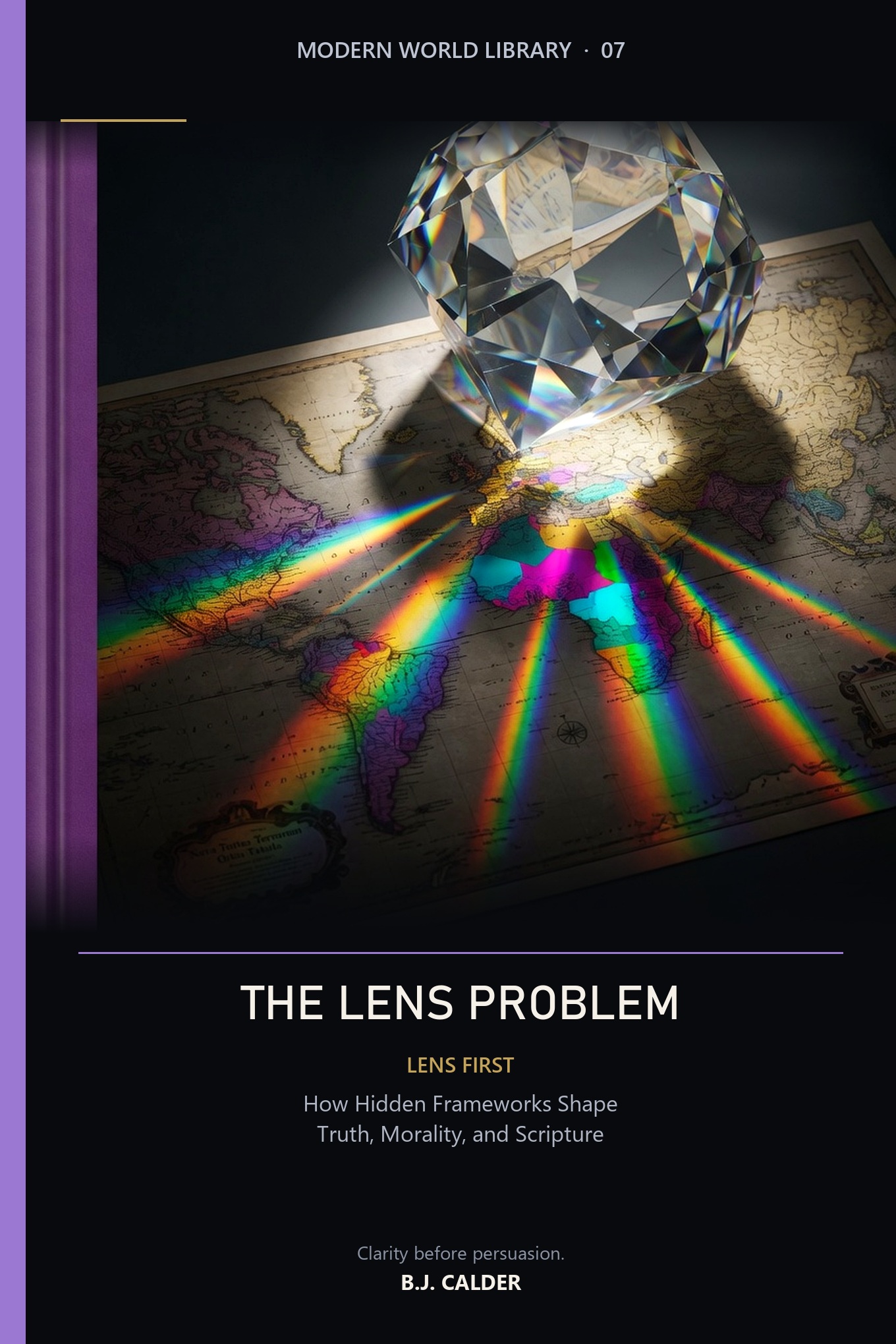
The Lens Problem — Free Sample
Reader Promise + Chapter 1 from Edition 2.0
Reader Promise
When you finish this book, you may still disagree with Christianity.
That is not the promise.
The promise is this. You will never evaluate the Bible, or a hard conversation about it, the same way again. You will recognise the lenses you read through. You will ask better questions. You will have cleaner conversations.
Whether you remain skeptical, become convinced, or land somewhere in the long middle, you will be better able to evaluate one of the most influential books in history with intellectual honesty.
This book does not promise that every hard passage will feel easy, that you will win the next family argument, or that evidence alone will dissolve moral offense. It will not replace a pastor, a therapist, or the slow work of whatever you believe about grace. What it will do is make it harder to pretend you have no lens, and easier to stay at the table when somebody else’s conscience is loud.
It promises to take your conscience seriously, whether you are a believer, a skeptic, or somewhere in between.
Clarity before persuasion.
Where the lens frame stopsMWL 07 §1
This book treats lens differences as real and powerful. It does not treat them as a way to dispose of arguments. That distinction is the whole ethics of the method, so it belongs here rather than buried in a later chapter.
Some objections are primarily lens-driven. People are answering different questions, weighing different moral goods, or talking past each other on separate tracks. Naming that can save a relationship and an evening.
Other objections are not lens-relative at all. They still stand after everyone has named their frameworks: basic logic, including the law of non-contradiction, which is the grammar of coherent speech rather than a Western preference. Clear internal contradictions in a position. Direct empirical claims that can be checked. Straightforward entailments of something someone just said.
The core rule: lens diagnosis is a clarifying step, not a concluding one. Once a lens has been named, or when the claim in front of you is logic or evidence or coherence, the substance still has to be engaged on its own terms. Naming a lens is never, by itself, a refutation.
So after you name one, ask:
What part of this objection still stands even after the lens is named?
If something still stands, answer that, or admit you do not yet have an answer. Do not relabel the remaining claim as just their lens so you can walk away clean.
There is a fair criticism of any lens framework, and this book accepts it rather than pretending it away. The risk is that the method becomes a universal deflection, where every difficult point gets redescribed as the other person’s framework and the force of the point quietly disappears. That risk is real. The discipline required is exactly the opposite: once the lens is visible, the remaining claim deserves full scrutiny. If this method is used to dodge rather than to clarify, it has failed, no matter how polished the vocabulary sounds.
The tools here are meant to work like a shared process, closer to good scientific practice than to a verdict delivered from a high horse. Make assumptions visible. Slow the inferences. Separate observation from interpretation. Leave room to update. They are not a licence to sit above a dispute while still arguing inside it.
This method helps surface hidden frameworks. It does not replace the need to decide what is actually true.
If you finish with a sharper conscience and a slower tongue, the promise held, whether or not you changed teams.
Begin when you are ready to be surprised by your own assumptions. Read with courage, patience, honesty, and care.
Chapter 1 – The Lens Problem
Part I – Name the Lens Vocabulary first. Before answers, before hard texts: learn to see the lens doing the work.
There is a particular conversation that believers keep losing, and they usually lose it while winning.
Someone raises God hardening Pharaoh’s heart. Or the slavery laws in the Old Testament. Or the death of David’s child, or the conquest of Canaan, or judgment that falls on a family or a nation instead of on one guilty man. And the believer does the responsible thing. They go and find the context. They come back with the genre, the historical setting, the distinction between what a text reports and what it commands, the way the Bible unfolds over time rather than arriving finished.
All of it is true and none of it lands.
The assumption underneath that failure is that the problem is missing information. Sometimes it is. Far more often your friend is not struggling with the facts of the Bible at all. They are struggling with whether the Bible’s moral vision is acceptable by their standards, and those standards are rarely neutral and almost never stated.
Because when your friend reads those passages, the reaction is not puzzlement. It is moral disgust. They do not think the passages are strange. They think they are wrong. And that reaction has already done most of the work in the conversation before anyone has said a word about Hebrew.
Here is the part that rarely gets said out loud. Your friend is usually applying a modern, Western lens shaped by individualism and by contemporary ideas about justice and harm. Inside that lens, justice is almost always individual, so only the guilty should suffer. Harm to the innocent is unacceptable whatever the larger purpose. Unequal treatment by ethnicity or status or gender is inherently oppressive. And a good God should be obvious to a thoughtful modern conscience.
None of those are self-evident cosmic truths. They are cultural assumptions that feel like common sense, and because they feel obvious they operate as an invisible lens. So when the Bible does not conform, the conclusion is rarely “this text comes from a different world.” The conclusion is “this God is morally defective.”
That is the lens problem, and it explains why more context keeps failing. You are answering what did this mean then while they are asking how can this possibly be good. Two serious people, two serious questions, no overlap. Until somebody names the lens, you will keep talking past each other and both of you will assume the other one is being difficult.
The lens is not the enemyMWL 07 §2
Naming a lens is not dismissing a conscience, and this is where believers most often ruin the move.
Some modern moral instincts are real gains over ancient cruelty. The revulsion at a child dying for a parent’s sin is not decadence, and the person feeling it is not soft. What naming the lens establishes is only that it is not neutral. It is one way of seeing among others. Treat it as the sole reasonable standard for reading an ancient text and the Bible will look immoral on contact, every time, before interpretation has begun.
It helps to notice that a lens can fail in more than one way, because “you’re wearing a lens” is heard as “your morality is fake” and that is not the claim. A lens can be true and incomplete, the way individual dignity is real without being the only moral language humans have ever spoken. It can be true and misapplied, the way consent genuinely matters but becomes a category error when it is the only tool brought to an ancient law code. And it can be false and powerful, in which case naming it is an act of justice rather than relativism. You can keep your conscience entirely intact and still admit that it walked into the room before the verb tense did.
Believers wear them too, which is the half of this that gets skipped. Prosperity assumptions. Nationalism. Therapeutic morality. A meek and mild Jesus assembled by someone who has never read a judgment text. The lens problem is not secular versus biblical. It is unexamined lens versus text on its own terms, and both of you may be wearing goggles you forgot you put on.
Naming it without a gotchaMWL 07 §3
The whole move can be made in one paragraph, and its tone matters more than its content.
“I think I’m starting to understand why this bothers you. You’re measuring these passages against a standard that says justice must be strictly individual, and that innocent people shouldn’t suffer for someone else’s actions. That’s a very common way of thinking today. What I keep coming back to is whether that’s the only fair standard for reading an ancient text, or whether the Bible is sometimes working with a different picture of justice and responsibility.”
That does three things at once. It shows you actually listened. It names the lens without sneering. And it moves the conversation from the Bible is evil toward we may be using different standards, which is the only ground on which anything further can happen.
Compare it to the alternative. Your friend says they could never worship a God who hardens hearts and then punishes people. The weak reply is “you don’t understand sovereignty,” which translates as you are ignorant, and the conversation is over whether or not either of you notices. The better reply grants the difficulty and then asks which difficulty it actually is: “You’re putting together two things that bother me too, God strengthening someone’s resolve and then judging what follows. Before I reach for theology charts, is your main problem that Pharaoh wasn’t free, that civilians died in the plagues, or that any God who runs the world this way isn’t worth worshiping? Those are related and they are not the same.”
Layers matter. Misalignment on which layer is in play causes hours of fog, and the fog always gets blamed on the other person’s stubbornness.
There are five ways to lose this that are worth naming, because each one feels righteous while you are doing it. Assuming bad faith the moment someone expresses moral disgust. Treating historical context like a spell that ends moral discussion. Confusing they are wrong about this passage with they are arguing dishonestly. Naming the lens as a put-down, as in “that’s just Western individualism.” And treating every doubter as a future trophy, which they will detect long before you admit it to yourself.
Questions worth carryingMWL 07 §4
These are not conversational weapons. Most of them are better asked of yourself first, and several of them will cost you something honest.
What would a good God look like to you, specifically? Are you judging the Bible by standards you also apply to other ancient texts, or only to this one? Is the objection to the text, to the people who misused it, or to both, and do you know which? If the moral problem were solved tomorrow, would belief still be blocked for other reasons? And which passage first made you think this God is not good, because there is almost always a first one, and it is rarely the one being argued about.
Then one for the believer, and it is the harder one. When moral disgust arrives, do you treat it as the end of the argument, or as data that a lens is now on the table?
The cost of refusing to ask is not abstract. A believer who will not name lenses buys performative certainty and friends who stop telling the truth. A skeptic who will not gets a permanent cartoon of “the Christian” and never has to meet one. A family gets holidays that function as trials. A group gets a club that calls itself a study.
The rest of this book is tools for paying a smaller price: questions, Case Files, hard texts with the weight left on, evidence kept in its lane, and dignity extended to people who stay and to people who leave.
It assumes you will try them in real rooms rather than only underline them. A lens named in private and never spoken still runs the conversation. Speak carefully, and speak soon enough that someone you love still wants to answer.
This week. Notice one conversation, about faith or family or work, where the feeling arrived before the reasons did. Write down the sequence in the order it actually happened. That sequence is the lens problem in miniature, and it is much easier to see in yourself when the stakes are low.
Continue reading the full edition for Parts II–V and appendices.